Ps. 51:15: “O Lord, open my lips, and my mouth shall show forth Your praise.”
אֲ֭דֹנָי שְׂפָתַ֣י תִּפְתָּ֑ח וּ֝פִ֗י יַגִּ֥יד תְּהִלָּתֶֽךָ
Parasha Lech Lecha
Bereshit: Ge. 12:1 – 17:27
Haftarah: Isa. 40:27 – 41:16
Brit Chadasha: 4:1 – 25
Parasha Lech Lecha
לֶךְ־לְךָ֛ meaning a command “to get out”
- Parasha Highlights:
- YaHaVah “calls” Abram
- YaHaVah makes “promises” to Abram secured by the Covenant of Pieces with circumcision being its seal.
- War of the kings
- Abram meets Melchizedek
- The “bridal selection” began in Ge. 2:7 and continued on with the eight souls on the ark. Twenty generations from Adam, Abram enters the biblical narrative.
- Ge. 12:1 – 5: Now YaHaVah had said to Abram: “Get out of your country, from your family and from your father’s house, to a land that I will show you. I will make you a great nation; I will bless you and make your name great; and you shall be a blessing. I will bless those who bless you, and I will curse him who curses you; and in you all the families of the earth shall be blessed.”
- The Fathers promise to Abram is for land and seed. Abrams great covenant nation will become the “bride” of the Mashiach.
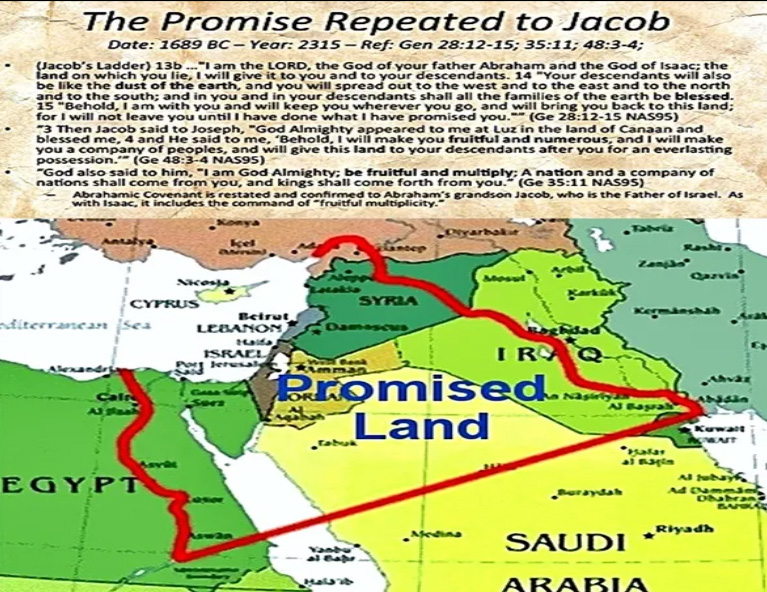
- Ge. 13:14 – 18: “And YaHaVah said to Abram, after Lot had separated from him: ‘lift your eyes now and look from the place where you are—northward, southward, eastward, and westward; for all the land which you see I give to you and your descendants forever. And I will make your descendants as the dust of the earth; so that if a man could number the dust of the earth, then your descendants also could be numbered. Arise, walk in the land through its length and its width, for I give it to you.’ Then Abram moved his tent, and went and dwelt by the terebinth trees of Mamre, which are in Hebron, and built an altar there to YaHaVah.”
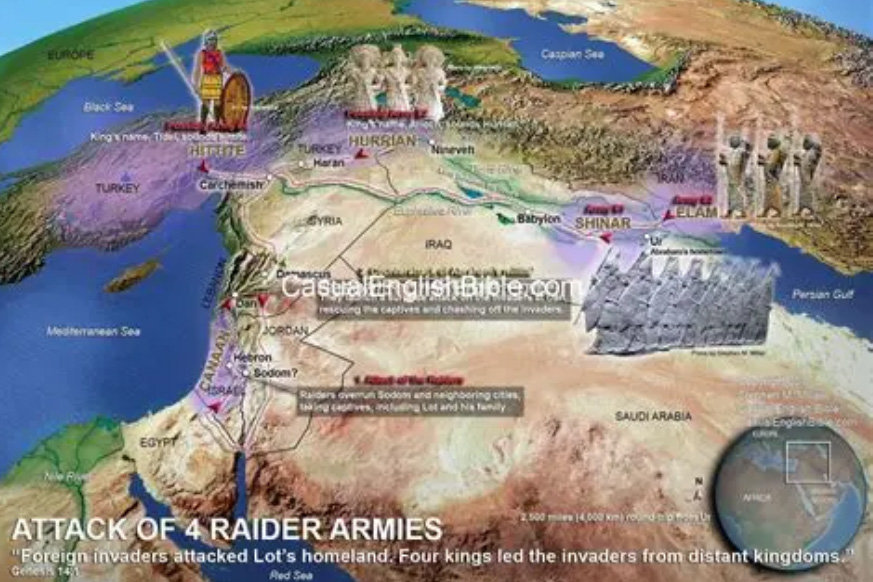
- Ge. 14:1-17: “And it came to pass in the days of Amraphel king of Shinar, Arioch king of Ellasar, Chedorlaomer king of Elam, and Tidal king of nations, that they made war with Bera king of Sodom, Birsha king of Gomorrah, Shinab king of Admah, Shemeber king of Zeboiim, and the king of Bela (that is, Zoar). All these joined together in the Valley of Siddim (that is, the Salt Sea). Twelve years they served Chedorlaomer, and in the thirteenth year they rebelled. In the fourteenth year Chedorlaomer and the kings that were with him came and attacked the Rephaim in Ashteroth Karnaim, the Zuzim in Ham, the Emim in Shaveh Kiriathaim, and the Horites in their mountain of Seir, as far as El Paran, which is by the wilderness.
- Then they turned back and came to En Mishpat (that is, Kadesh), and attacked all the country of the Amalekites, and also the Amorites who dwelt in Hazezon Tamar. And the king of Sodom, the king of Gomorrah, the king of Admah, the king of Zeboiim, and the king of Bela (that is, Zoar) went out and joined together in battle in the Valley of Siddim against Chedorlaomer king of Elam, Tidal king of nations, Amraphel king of Shinar, and Arioch king of Ellasar—four kings against five. Now the Valley of Siddim was full of asphalt pits; and the kings of Sodom and Gomorrah fled; some fell there, and the remainder fled to the mountains. Then they took all the goods of Sodom and Gomorrah, and all their provisions, and went their way. They also took Lot, Abram’s brother’s son who dwelt in Sodom, and his goods, and departed.
- Then one who had escaped came and told Abram the Hebrew, for he dwelt by the terebinth trees of Mamre the Amorite, brother of Eshcol and brother of Aner; and they were allies with Abram. Now when Abram heard that his brother (Lot) was taken captive, he armed his three hundred and eighteen trained servants who were born in his own house, and went in pursuit as far as Dan. He divided his forces against them by night, and he and his servants attacked them and pursued them as far as Hobah, which is north of Damascus. So he brought back all the goods, and also brought back his brother Lot and his goods, as well as the women and the people. And the king of Sodom went out to meet him at the Valley of Shaveh (that is, the King’s Valley), after his return from the defeat of Chedorlaomer and the kings who were with him.”
- Who are the nine kings that were involved in this conflict?
- Amraphel King of Shinar: Shinar = southern Mesopotamia (Sumer/Babylonia).
- Arioch King of Ellasar: Ellasar is best explained as Larsa, 32 km southeast of Uruk.
- Chedorlaomer King of Elam: The toponym Elam points to modern Khūzestān, Iran.
- Tidal King of Nations (“Goyim”): Tidal aligns with the Anatolian royal name Tudḫaliya, people of the Zagros region.
- The first four kings CAME FROM THE NORTH.
- Bera of Sodom, Birsha of Gomorrah, Shinab of Admah, Shemeber of Zeboiim, and “the king of Bela (Zoar)” governed walled cities excavated at Bab edh-Dhra, Numeira, and Feifa. (/biblehub.com/q/Significance_of_Genesis_14_1_kings.)
- I am a visual person so I have a map for you to examine.
- An interesting point in this parasha is the war with the nine kings directly follows the covenant of promise given to Abram.
- Ge. 15:17 restates the boundaries of land promised to Abram. “And it came to pass, when the sun went down and it was dark, that behold, there appeared a smoking oven and a burning torch that passed between those pieces. On the same day YaHaVah made a covenant with Abram, saying: ‘to your descendants I have given this land, from the river of Egypt to the great river, the River Euphrates—the Kenites, the Kenezzites, the Kadmonites, the Hittites, the Perizzites, the Rephaim, the Amorites, the Canaanites, the Girgashites, and the Jebusites.’”
- The narrative tells us in Ge. 14:5: “And in the fourteenth year came Chedorlaomer …”
- Chedorlaomer, King of Elam, was the monarch of what is now modern-day Iran. The Masorites noted that this phrase, “in the fourteenth year,” occurs twice in the Tanakh. The second occurrence appears in 2 Kings 18:13: “In the fourteenth year of King Hezekiah did Sennacherib, king of Assyria, come up against all the fenced cities of Judah and took them.”
- The campaigns against Israel speak to the covenant people as the fourteenth day of the first month is Pesach, Passover, which is a covenant appointed time.
- The question for us is why?
- R’ Yeshayahu Horowitz, known as the Shelah, describes the objective of kidnapping Lot; “…their prime purpose became to prevent the emergence of a Jewish people and thus to frustrate the concept of the Messiah and what he represents.” Shney Luchot HaBrit, Lech-Lecha, Volume 1, translated by Eliyahu Munk, pg. 83
- I would add to this commentary the following: I believe this conflict is a physical manifestation of the “seed war” of Ge. 3:15. This conflict is also a prophetic picture of future wars.
- The “seed” war” totally explains why the nations of the world choose to fight against Israel, because she is His chosen land and people.
- Psalms 2:1-4: “Why do the nations rage, and the peoples plot a vain thing? The kings of the earth take a stand, and the rulers take counsel together against YaHaVah and against his Mashiach, saying, ‘let’s break their bonds apart and cast their cords from us.’ He who sits in the heavens will laugh. YaHaVah will have them in derision.”
- In Joshua 9, the kings came to fight against Joshua (who is called Yeshua in Nehemiah 8): “It happened when all the kings who were beyond the Jordan, in the hill country, and in the lowland, and on all the shore of the great sea in front of Lebanon, the Hittite,
- the Amorite, the Canaanite, the Perizzite, the Hivite, and the Jebusite, heard of it that they gathered themselves together to fight with Joshua and with Israel, with one accord (literally, “with one mouth.”)
- Rev. 19:19: “And I saw the beast, and the kings of the earth, and their armies, gathered together to make war against him that sat on the horse, and against his army.”
- At the end of the Messianic Era, after the 1000 year reign of the Mashiach, the ultimate Sukkot, there will be the final manifestation of Gog and Magog.
- The kings of the earth, including what is known as the United Nations, continue to come against Am Israel, the people Israel.
- Ez. 38:1 – 9: “The word of YaHaVah came to me, saying, ‘Son of man, set your face toward Gog, of the land of Magog, the prince of Rosh, Meshech, and Tubal, and prophesy against him, and say, thus says YaHaVah: Behold, I am against you, Gog, prince of Rosh, Meshech, and Tubal: and I will turn you around, and put hooks into your jaws, and I will bring you forth, with all your army, horses and horsemen, all of them clothed in full armor, a great company with buckler and shield, all of them handling swords; Persia, Cush, and Put with them, all of them with shield and helmet; Gomer, and all his hordes; the house of Togarmah in the uttermost parts of the north, and all his hordes; even many peoples with you. Be prepared, yes,
- prepare yourself, you, and all your companies who are assembled to you, and be a guard to them. After many days you shall be visited: in the latter years you shall come into the land that is brought back from the sword, that is gathered out of many peoples, on the mountains of Israel, which have been a continual waste; but it is brought forth out of the peoples, and they shall dwell securely, all of them. You shall ascend, you shall come like a storm, you shall be like a cloud to cover the land, you, and all your hordes, and many peoples with you.”
- 2 Kings 17:5 – 6: “Now the king of Assyria went throughout all the land, and went up to Samaria and besieged it for three years.
- In the ninth year of Hoshea, the king of Assyria took Samaria and carried Israel away to Assyria, and placed them in Halah and by the Habor, the River of Gozan, and in the cities of the Medes.
- 2 Kings 18:11 – 12: “Then the king of Assyria carried Israel away captive to Assyria, and put them in Halah and by the Habor, the River of Gozan, and in the cities of the Medes, because they did not obey the voice of YaHaVah their Elohay, but transgressed His covenant and all that Moses the servant of YaHaVah had commanded; and they would neither hear nor do them.” **The Assyrian captivity of the Israelites began in approximately 732 BCE and continued until the Babylonian captivity in 587 BCE.
- 2 Kings 24:10 – 14: “At that time the servants of Nebuchadnezzar king of Babylon came up against Jerusalem, and the city was besieged. And Nebuchadnezzar king of Babylon came against the city, as his servants were besieging it. Then Jehoiachin king of Judah, his mother, his servants, his princes, and his officers went out to the king of Babylon; and the king of Babylon, in the eighth year of his reign, took him prisoner. And he carried out from there all the treasures of the house of YaHaVah and the treasures of the king’s house, and he cut in pieces all the articles of gold which Solomon king of Israel had made in the temple of YaHaVah, as YaHaVah had said. Also he carried into captivity all Jerusalem: all the captains and all the mighty men of valor, ten thousand captives, and all the craftsmen and smiths. None remained except the poorest people of the land.
- The Babylonian Captivity, the forced detention of Jews in Babylonia following the Neo-Babylonian Empire’s conquest of the kingdom of Judah in 598/7 and 587/6 bce.
- During the years since Israel statehood on 5-15-1948 see the following: Arab-Israeli wars, series of military conflicts between Israeli forces and various Arab forces, most notably in 1948–49, 1956, 1967, 1973, 1982, and 2006.
- We have witnessed the most recent attack of 10-7-22 – today. In my opinion, the war of the kings, the “seed war” will not conclude until Ezekiel’s prophecy.
Haftarah
- Is. 40:27 – 41:16
- We have a few connections to the parasha: V 31: “But those who wait on YaHaVah shall renew their strength; they shall mount up with wings like eagles, they shall run and not be weary, they shall walk and not faint. **Can you see the life of Abraham in this verse?
- 41:4 “Who has performed and done it, calling the generations from the beginning? ‘I, YaHaVah, am the first; and with the last I am He.’”
- This certainly speaks to Abraham in the beginning and his “seed” in the final generation.
- Finally v 8 – 10 “But you, Israel, are My servant, Jacob whom I have chosen, the descendants of Abraham My friend. You whom I have taken from the ends of the earth, and called from its farthest regions, and said to you, ‘You are My servant, I have chosen you and have not cast you away’”
Brit Chadasha
- Acts 7:1-8 The call of Abraham.
- Rom. 3:19 – 5:6 It would be in your best interest to study these passages because the connections are numerous.
- Gal. 3:15-18: “He trusted in YaHaVah and was faithful to him, and that was credited to his account as righteousness.”
- Col. 2: 11 – 15 speaks to circumcision, aligning your foreskin as sin, your old nature.
- Heb. 7: 1-9 The encounter with Melchizedek.
- In conclusion, we know that the “covenants of promise,” i.e. land and seed, will one day come to a complete fruition.
- The same kings of Ge. 14 are still coming against Israel, a small nation that has yet to be given her emtire biblical boundaries.
- Yeshua said in Lk. 21:20 – 28: “…when you see Jerusalem surrounded by armies, then know that its desolation is at hand. Then let those who are in Judea flee to the mountains. Let those who are in the midst of her depart. Let those who are in the country not enter therein.
- For these are days of vengeance, that all things which are written may be fulfilled. Woe to those who are pregnant and to those who nurse infants in those days! For there will be great distress in the land and wrath to this people. They will fall by the edge of the sword and will be led captive into all the nations. Jerusalem will be trampled down by the Gentiles until the times of the Gentiles are fulfilled. There will be signs in the sun, moon, and stars; and on the earth anxiety of nations, in perplexity for the roaring of the sea and the waves; men fainting for fear, and for the expectation of the things which are coming on the world: for the powers of the heavens will be shaken. Then they will see the Son of Man coming in a cloud with power and great glory. But when these things begin to happen, look up and lift up your heads because your redemption is near.”
Listen closely, can you hear the footsteps of the Mashiach?
עקבתא דמשיחא