Parasha Chayei Sarah
Bereshit (Genesis) 23:1 – 25:18
Haftarah: M’lakhim Aleph (1st Kings) 1:1 – 31
Brit Chadasha: Mt. 8:19 – 22; 27:3 – 10;
and Lk. 9:57 – 62
Parasha Chayei Sarah
חַיֵּ֣י שָׂרָ֔ה meaning “the life of Sarah”
- Parasha Highlights:
- The death of Sarah
- The purchase of the burial cave at Machpelah
- Eliezer, the servant of Abraham, seeks a wife for Isaac i.e. the 10 camels for the 10 virgins
- The death of Abraham
- Our Parasha opens in Ge. 23:1 – 9: “Sarah lived one hundred and twenty and seven years (1 + 2 + 7 = 10); these were the years of the life of Sarah. So Sarah died in Kirjath Arba (that is, Hebron) in the land of Canaan, and Abraham came to mourn for Sarah and to weep for her. Then Abraham stood up from before his dead, and spoke to the sons of Heth, saying, ‘I am a foreigner and a visitor among you. Give me property for a burial place among you, that I may bury my dead out of my sight.’ And the sons of Heth answered Abraham, saying to him, ‘hear us, my lord: You are a mighty prince among us; bury your dead in the choicest of our burial places. None of us will withhold from you his burial place, that you may bury your dead.’
- Then Abraham stood up and bowed himself to the people of the land, the sons of Heth. And he spoke with them, saying, ‘if it is your wish that I bury my dead out of my sight hear me, and meet with Ephron the son of Zohar for me, that he may give me the cave of Machpelah ( double portion ) which he has, which is at the end of his field. Let him give it to me at the full price, as property for a burial place among you.’” **The full price was 400 shekels of silver.
- The title of this sidra is “the life of Sarah” but immediately opens with her death. What do we really know about her life?
- This teaching will track the “bridal selection” through the wife of Abraham, Sarah. At the time of Abrahams call from YaHaVah, he was married to Sarah.
- Consider the covenant of promise also included Sarah as Abraham alone would not be able to bear his own descendants. In fact, the 400 silver shekels tell us that her direct descendant would be Yeshua, the Aleph Tav. We must recognize she walked in obedience to The Fathers call just as Abraham did.
- Abraham was called to a divine mandate and she followed. Sarah would become the mother of the “whole house of Israel.”
- Ge. 11:30 tells us that she was barren: “But Sarai was barren; she had no child.” **Sarah remained barren until she conceived and gave birth to Isaac, the promised seed.
- The Hebrew word for “barren” is עָקָר which is used only 12 times in the Tanakh. The numerical value of “aqar” is 370; 3 + 7 = 10. In its ancient form, “aqar” would read; “Watch for the One who would be least, the One who was from the beginning.”
- It will require the intervention of YaHaVah at an appointed time in order for her to conceive and bear fruit. The fruit of her womb will be both physical and spiritual.
- One of her descendants will be David the King. Our Haftarah will speak to the death of David, HaMelech.
- Barrenness is also a reference to the nation Israel.
- Is. 54:1: “Sing, O barren, you who have not borne! Break forth into singing, and cry aloud, you who have not labored with child! For more are the children of the desolate than the children of the married woman, says YaHaVah.”
- The nation of Israel will bear spiritual fruit only with the intervention of the spirit of Holiness. See Acts 2.
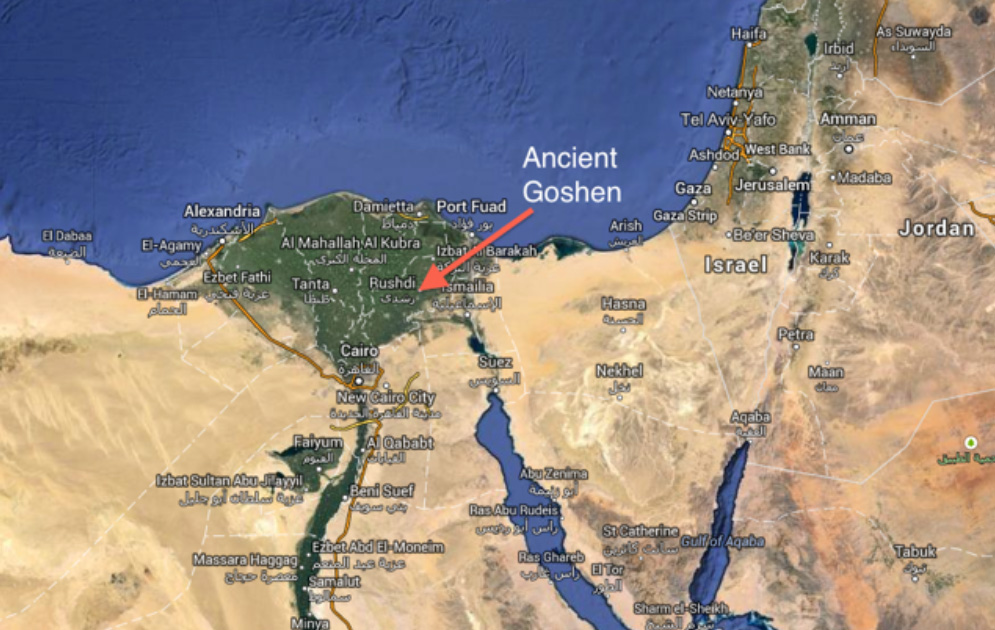
- Though her womb was empty she was gifted another womb, Goshen. The midrash tells us…As a token of his love for Sarah, the king deeded his entire property to her, and gave her the land of Goshen as her hereditary possession. (Pirkei R. Eliezer xxvi., pg. 218)
- Goshen is shaped like a womb. The physical “seed” of Sarah would become a multitude of Israelites in the womb of Goshen. Israel would be safe in this land so it’s no surprise that the numerical value of the word Goshen,גשן , should equal 353; 3 + 5 + 3 = 11, a number that speaks to Yeshua, whose root word is Y’sha, meaning to be saved. It is no surprise that Yeshua our Mashiach would come “out of Egypt” as recorded in Hos. 11:1 and fulfilled in Mt. 2:15.
- Hos. 11:1: “When Israel was a child, I loved him, and out of Egypt I called My son.”
- Mt. 2:15: “And was there until the death of Herod: that it might be fulfilled which was spoken of the Lord by the prophet, saying, out of Egypt have I called my son.”
- The life of Sarah is a juxtaposition (the fact of two things being seen or placed close together with contrasting effect); essentially from barrenness (no seed) to fruitfulness (the mother of nations).
- The seed of Sarah was to be the mother of nations beginning with the nation of Israel. The seed of Sarah would produce Isaac. Isaac and Rebecca would produce Jacob/Israel. Jacob and his four wives would produce the twelve tribes of Israel. Israel is then referred to as the “green olive tree” in Jere. 11:16.
- Ps. 135:4: “For YaHaVah has chosen Jacob for Himself, Israel for His special treasure.”
Haftarah
M’lakhim Aleph (1st Kings) 1:1 – 31:
- 2nd Sam. 5:4: “David was thirty years old when he began to reign, and he reigned forty years.” King David dies at age 70.
- The number 70 itself is significant, as it is equivalent in gematria to the word sod or secret. The life of King David is a mystery waiting to be unraveled.
- 1st Ki. 1:1 – 2: “Now King David was old, advanced in years; and they put covers on him, but he could not get warm. Therefore his servants said to him, ‘let a young woman, a virgin, be sought for our lord the king, and let her stand before the king, and let her care for him; and let her lie in your bosom, that our lord the king may be warm.’”
- David is spelled דוד, the numerical value of which is fourteen. The number fourteen speaks to the appointed time of Pesach or Passover as this festival occurs on the fourteenth day of the first month. Pesach is a covenant appointed time. This tells us David should have something else to show us about covenant.
- In fact, it is called the “Davidic covenant.”
- 2nd Sam. 7:12 – 13: “When your days are fulfilled and you rest with your fathers, I will set up your seed after you, who will come from your body, and I will establish his kingdom. He shall build a house for My name, and I will establish the throne of his kingdom forever.”
- YaHaVah called David a man after His own heart in 1st Sam. 13:14: “But now your kingdom shall not continue. YaHaVah has sought for Himself a man after His own heart, and YaHaVah has commanded him to be commander over His people, because you have not kept what YaHaVah commanded you.”
- David, the son of Jesse, didn’t begin his life as an exalted king. Below are two Scriptures that reflect David’s opinion of himself.
- Ps. 51:5-6: “Behold, I was brought forth in iniquity. In sin, my mother conceived me.”
- This is a baffling statement. What were the circumstances of this “sin”? Why was he treated as an outcast among his own brothers, as he explains in Psalm 69:8 – 9: “I have become a stranger to my brothers, an alien to my mother’s children.”
- Recall when the prophet Samuel was told by Yah to seek one of Jesses’ sons.
- 1st Sam. 16:1 – 3: “Now YaHaVah said to Samuel, ‘how long will you mourn for Saul, seeing I have rejected him from reigning over Israel? Fill your horn with oil, and go; I am sending you to Jesse the Bethlehemite. For I have provided Myself a king among his sons.’ And Samuel said, ‘how can I go? If Saul hears it, he will kill me.’ But YaHaVah said, ‘take a heifer with you, and say, I have come to sacrifice to YaHaVah. Then invite Jesse to the sacrifice, and I will show you what you shall do; you shall anoint for Me the one I name to you.’”
- Yishai, the father of David, was a Torah scholar but tormented by a halachic (Hebrew Rabbinic law) question as to the legitimacy of his marriage to Nitzevet. The reason is that he was descended from Ruth the Moabitess. The question surrounded the interpretation of Deuteronomy 23:3, that no Moabite should enter the Assembly of YaHaVah. While the halacha dictated that this verse only applied to a male Moabite, it was not widely known, hence the doubt of Yishai. Rashi comments on Micah 5:2….
- “And you, Bethlehem Ephrathah: whence David emanated, as it is stated (I Sam. 17:58): “The son of your bondsman, Jesse the Bethlehemite.” And Bethlehem is called Ephrath, as it is said (Gen. 48:7): “On the road to Ephrath, that is Bethlehem.”
- you should have been the lowest of the clans of Judah: You should have been the lowest of the clans of Judah because of the stigma of Ruth the Moabitess in you. From you shall emerge for Me: the Messiah, son of David, and so Scripture says (Ps. 118:22): “The stone the builders had rejected became a cornerstone.” And his origin is from of old: “Before the sun his name is Yinnon” (Ps. 72:17).”
- On an aside, lets examine this Scripture. Ps. 72:17: “His name shall endure forever; His name shall continue (Yinnon – יִנּ֪וֹן) as long as the sun. And men shall be blessed in Him; all nations shall call Him blessed.”
- The numerical value of “Yinnon” is 116; 1 + 1 + 6 = 8.
- Thinking himself unfit to marry a Jewess and intending to put Nitzevet away, he decided to marry a Canaanite servant. But like Rachel and Leah, Nitzevet and the servant switched places, and King David was conceived. When Nitzevet’s belly began to show, it was suspected that she committed adultery and that David was a mamzer, an illegitimate child.
- “After three months, Nitzevet’s pregnancy became obvious. Incensed, her sons wished to kill their apparently adulterous mother and the “illegitimate” fetus that she carried.
- Nitzevet, for her part, would not embarrass her husband by revealing the truth of what had occurred. Like her ancestress Tamar, who was prepared to be burned alive rather than embarrass Judah, Nitzevet chose a vow of silence. And like Tamar, Nitzevet would be rewarded for her silence with a child of greatness who would be the forebear of Mashiach.”
- Understanding this background, we may now understand why Yishai did not bring David out with his brothers to meet Samuel the Prophet,
- 1st Sam. 16:11-12: “Samuel said to Jesse, ‘are all your children here?’ He said, ‘there remains yet the youngest, and behold, he is keeping the sheep.’”
- After seeing the older brothers of David, Samuel, looking on the outward, the external, thought he had found the Chosen One, but YaHaVah told him to look at the pnimiyut, the internality.
- 1st Sam. 16:6-7: “It happened, when they had come, that he looked at Eliav and said, surely YaHaVah Mashiach is before him. But YaHaVah said to Samuel, ‘do not look on his face, or on the height of his stature; because I have rejected him: for I see not as man sees; for man looks at the outward appearance, but YaHaVah looks at the heart.’”
- Finally, David was brought before Samuel.
- 1st Sam. 16:12: “He sent and brought him in. Now he was ruddy, and withal of a beautiful face, and goodly to look on. YaHaVah said, ‘arise, anoint him, for this is he.’”
- Acts 13:22: “And when He had removed him, He raised up David to be their king, of whom He testified and said, ‘I have found in David the son of Jesse a man after my heart, who will do all my will.’”
Yeshua ben David
- Mt. 12:23: “All the multitudes were amazed and said, ‘can this be the son of David?’”
- The people of Israel asked this question about Yeshua of Nazareth. Yeshua is referred to as the “son of David” in the New Testament as follows, Matthew 1:1, 9:27, 15:22, 20:30-31, 21:9, 15; Mark 10:47-48, 11:10 ; Luke 1:32, 18:38-39 ; Romans 1:3; 2 Timothy 2:8, Revelation 22:16. There is no doubt that the early believers saw Yeshua as not only descended from David but also the fulfillment of the expectations of Mashiach ben Yosef and Mashiach ben David to come. The very first line of the New Testament states…
- Mt. 1:1: “A record of the genealogy of Yeshua the Messiah, the son of David, the son of Abraham.”
Brit Chadasha
- Mt. 8:19 – 22: v 22 “But Yeshua replied, ‘follow me, and let the dead bury their own dead.’”
- Mt. 27:3 – 10: Speaks to the purchase of a burial field.
- Lk. 9:57 -62: Let the dead bury their own dead.
- In conclusion, Sarah was indeed ashamed of her barrenness. She faced significant pressure in her society, where a woman’s worth was often tied to her ability to provide heirs. Despite her advanced age and years of waiting, Sarah’s barrenness was a source of deep shame and disappointment. However, it was through her faith and God’s miraculous intervention that she ultimately bore Isaac, fulfilling God’s promise to Abraham. This narrative illustrates the emotional and spiritual struggles associated with barrenness in biblical times.
- (biblestudyresources.org+4)
- The link to our Parasha and our Haftarah is shame and death. Sarah’s shame for having been barren and David’s shame for his questionable heritage.
- The remedy for both was Yahs intervention. Sarah became the matriarch of all the descendants of Abraham while David was actually one of those descendants.
- Both arose to their own elevated status within the House of Israel.
- During the Chayei Sarah, she was a virgin, a daughter, a sister, a wife, barren and for thirty seven years, a mother. Many of these titles can also apply to Israel.