Sh’mot (Exodus) 25:1 – 27:19
Haftarah: M’lakhim Aleph (1st Ki.) 5:26 – 6:13
Brit Chadasha: Heb. 8:1 – 6; 9:23 – 24 and 10:1
Parasha Terumah
תְּרוּמָה meaning “contribution or offering”
- Parasha Highlights:
- Instructions are given regarding contributions from the people for His portion, the Mishkan and its furnishings: The Ark, its cover, the Table and Menorah, covers over the Mishkan, its walls and partitions, the great altar and the courtyard.
- Ex. 25:1 – 7: “Then YaHaVah spoke to Moshe, saying: ‘speak to the children of Israel, that they bring Me an offering. From everyone who gives it willingly with his heart you shall take My offering and this is the offering which you shall take from them: gold, silver, and bronze; blue, purple, and scarlet thread, fine linen, and goats’ hair; ram skins dyed red, badger skins, and acacia wood; oil for the light, and spices for the anointing oil and for the sweet incense; onyx (Shoham) stones, and stones to be set in the ephod and in the breastplate.’”
- The Hebrew word for “heart” is לֵב. Lav is defined as the inner man, mind, will, heart or understanding. The numerical value is 32; 3 + 2 = 5. The number five speaks to the first five books of Scripture, The Torah.
- The Lamed and the Bet spell Lav, heart. These letters are the bookends, i.e. the beginning and the end, of His Torah.
- With this in mind, the willing heart of a man would be a heart focused on His Torah. 1st Sam. 13:14: “But now thy kingdom shall not continue: YaHaVah hath sought him a man after his own heart, and YaHaVah hath commanded him to be captain over his people, because thou hast not kept that which YaHaVah commanded thee.”
- The man Samuel is referring to is young David, the son of Jesse, the son of Obed, the son of Boaz and Ruth. David will be the anointed king of Israel replacing Saul because of his own disobedience. Saul did not possess a “willing heart.”
- Ps. 24:1 – 4: “A Psalm of David: The earth is YaHaVahs’, and all its fullness, the world and those who dwell therein. For He has founded it upon the seas, and established it upon the waters. Who may ascend into the hill of YaHaVah? Or who may stand in His holy place? He who has clean hands and a pure heart, who has not lifted up his soul to an idol, nor sworn deceitfully.”
- If a pure heart is a Torah focused heart, then there must be a heart that is in opposition to Torah. The first mention of “heart” is recorded in Ge. 6:5: “Then YaHaVah saw that the wickedness of man was great in the earth, and that every intent of the thoughts of his heart was only evil continually.”
- The heart of all believers will either be a wicked heart or a pure heart. The wicked heart is one who chooses to walk away from Torah while the pure heart is one who chooses to walk in Torah obedience which equals covenant faithfulness.
- The prophet Ezekiel says it this way: Ez. 36:24 – 27: “For I will take you from among the nations, gather you out of all countries, and bring you into your own land. Then I will sprinkle clean water on you, and you shall be clean; I will cleanse you from all your filthiness and from all your idols. I will give you a new heart and put a new spirit within you; I will take the heart (אֶת־לֵ֤ב ) of stone out of your flesh and give you a heart of flesh. I will put My Spirit within you and cause you to walk in My statutes, and you will keep My judgments and do them.” **The new heart has a direct link to Torah obedience.
- This block of Scripture is speaking to the Northern Kingdom as YaHaVah divorced them as recorded in Jer 3:8. These are they who were scattered to the nations because of their disobedience.
- The Hebrew word for “new” is חָדָשׁ which can be defined as a “new wife.” YaHaVah will take the divorced wife from the nations and give her a “new” restored heart for Torah obedience, she will become a “new wife.”
- Jer. 31:33: “But this is the covenant that I will make with the house of Israel after those days, says YaHaVah: I will put My law in their minds, and write it on their hearts; and I will be their El, and they shall be My people.” **This event will occur when Yeshua restores the divided kingdom at the onset of His millennial kingdom.
- Those with a “willing heart” will provide for the offering, the Terumah, the אֶת־תְּרוּמָתִֽי. Notice there are two Tavs used in the spelling of this word. Is it possible it is speaking to both covenants, i.e. the Abrahamic covenant and the restored Abrahamic covenant?
- This spelling is actually conveying a deeper meaning. This word means “My offering.” The “My offering” is speaking to The Fathers offering, none other than His only begotten Son, Yeshua HaMashiach whom He will offer for humanity.
- Ex. 25:8 – 22: “And let them make Me a sanctuary, that I may dwell among them. According to all that I show you, that is, the pattern of the tabernacle and the pattern of all its furnishings, just so you shall make it. And they shall make an ark of acacia wood; two and a half cubits shall be its length, a cubit and a half its width, and a cubit and a half its height. And you shall overlay it with pure gold, inside and out you shall overlay it, and shall make on it a molding of gold all around. You shall cast four rings of gold for it, and put them in its four corners; two rings shall be on one side, and two rings on the other side. And you shall make poles of acacia wood, and overlay them with gold. You shall put the poles into the rings on the sides of the ark, that the ark may be carried by them.
- The poles shall be in the rings of the ark; they shall not be taken from it. And you shall put into the ark the Testimony which I will give you. You shall make a mercy seat of pure gold; two and a half cubits shall be its length and a cubit and a half its width. And you shall make two cherubim of gold; of hammered work you shall make them at the two ends of the mercy seat. Make one cherub at one end, and the other cherub at the other end; you shall make the cherubim at the two ends of it of one piece with the mercy seat. And the cherubim shall stretch out their wings above, covering the mercy seat with their wings, and they shall face one another; the faces of the cherubim shall be toward the mercy seat. You shall put the mercy seat on top of the ark, and in the ark you shall put the Testimony that I will give you.
- And there I will meet with you, and I will speak with you from above the mercy seat, from between the two cherubim which are on the ark of the Testimony, about everything which I will give you in commandment to the children of Israel.”
- The very first article of furniture is the Ark, the Ark of the Covenant. The Hebrew word for “ark” is אָרוֹן which is defined as a chest, ark money chest, Ark of the Covenant or a (TWOT) coffin. In this case, I believe this Ark can be considered a treasure chest. This treasure chest will house the two stone tablets engraved by the hand of Moshe containing the Ten Words. These tablets are the two witnesses to His covenant.
- Mt. 6:19 – 21: “Do not lay up for yourselves treasures on earth, where moth and rust destroy and where thieves break in and steal; but lay up for yourselves treasures in heaven, where neither moth nor rust destroys and where thieves do not break in and steal for where your treasure is, there your heart will be also.”
- Mt. 12:35: “A good man out of the good treasure of his heart brings forth good things, and an evil man out of the evil treasure brings forth evil things.”
- A good mans treasure equals a man with a willing heart, a heart for Torah!
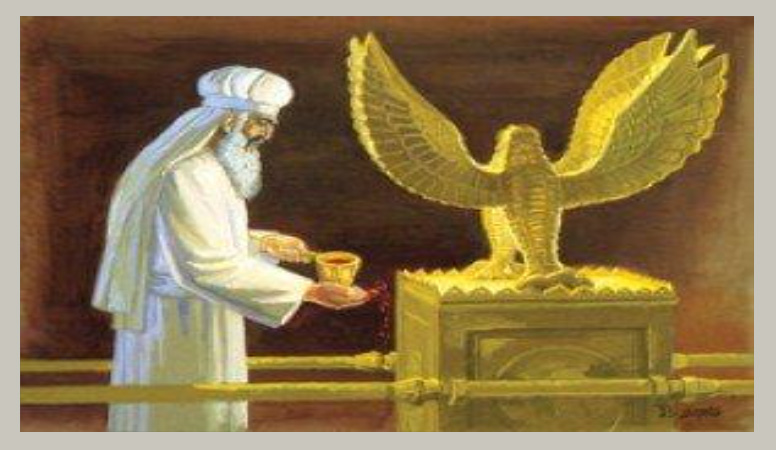
- Atop the Ark of the Testimony is the “mercy seat.” The Hebrew word for “mercy seat” is the כַּפֹּרֶת. It will be this very location where Yeshua, the lawgiver, will dispense either mercy or judgment.
- Jn. 9:39: “And Yeshua said, ‘for judgment I came into this world, so that those who do not see may see, and that those who see may become blind.”
- His judgement will be based on our obedience to The Fathers heart, His Torah. Rom. 2:12: “For as many as have sinned without law will also perish without law, and as many as have sinned in the law will be judged by the law.”
- Kapporet is spelled with the letters Kaph, Pey, Resh and Tav. Lets take a minute to see what this word is telling us.
- The letter Kaph is a picture of an open hand and means to open, allow or cover. This letter speaks to the words of Yeshua in Mt. 11:28: “Come to Me, all you who labor and are heavy laden, and I will give you rest.” This is His open hand of invitation to enter the kingdom.
- The letter Pey is a picture of an open mouth and means to speak. Yeshua spoke freely of His Fathers doctrine in Jn. 7:16: “So Yeshua answered them and said, ‘My teaching is not Mine, but His who sent Me.”
- Also, Jn. 12:49 – 50: “For I did not speak on My own initiative, but the Father Himself who sent Me has given Me a commandment as to what to say and what to speak. I know that His commandment is eternal life; therefore the things I speak, I speak just as the Father has told Me.”
- The letter Resh is a picture of the head of man and means first, beginning and head. Yeshua speaks continuously of the preeminence of The Father.
- Jn. 20:17: “Go instead to my brothers and tell them, ‘I am ascending to my Father and your Father, to my God and your God.’”
- The letter Tav is a picture of crossed sticks and means mark, seal or covenant. This letter says is all. If we choose to come to The Father through Yeshua we will have the opportunity to enter the kingdom, having been marked and sealed while walking in covenant obedience.
Haftarah
- M’lakhim Alef ( 1st Kings ) 5:26 – 6:13
- The connection to our Parasha is as follows:
- The Parasha speaks to the instructions for the building of the Mishkan. Our Haftarah speaks to the building of Solomon’s Temple.
Brit Chadasha
- Heb. 8:1 – 6: “See to it that you make everything according to the pattern you were shown on the mountain.”
- Heb. 9:25 – 26: “Nor yet that he should offer himself often, as the high priest enters into the holy place every year with blood of others; For then must he often have suffered since the foundation of the world: but now once in the end of the world has he appeared to put away sin by the sacrifice of himself.”
- Heb. 9:27 – 28: “And as it is appointed unto men once to die, but after this the judgment. So Messiah was once offered to bear the sins of many; and unto them that look (watch) for him shall he appear the second time without sin unto salvation.”
- The Book of Hebrews is about Yom Kippurim, the sixth of YaHaVahs’ festivals. This festival is a single day and occurs once a year. The blood of the goat is sprinkled upon the Ark of the Covenant.
- In conclusion, the heart of The Father is expressed in His Torah which He willingly gave to us. Our willing heart is not just silver and gold rather it is expressed in our love and obedience to His Torah.
- The Ark of the Covenant will house the “testimony” of the two witnesses, the two stone tablets etched with the Ten Words.
- The Kapporet is the “mercy and judgement” seat of Yeshua. The place where He will dispense either.
- 1st John 4:19: “We love Him because He first loved us.”