By: Phyllis R. Reid, a bondservant of Yeshua HaMashiach
December 21, 2025
The Altars of Yah
- There are many altars dedicated to The Father recorded in the Scripture narrative. The question for us is, what is their significance?
- The first mention of an altar dedicated to Yah is recorded in Ge. 8:20: “Then Noah built an altar to YaHaVah, and took of every clean animal and of every clean bird, and offered burnt offerings on the altar.”
- Any altar dedicated to YaHaVah is for the purpose of establishing His preeminence on the earth. If this is a correct deduction, then something should have occurred prior to the first altar having been erected.
- Recall the week of creation, specifically The Fathers’ declaration that each day, with the exception of day two, was declared “good.” The word “good-tov” tells us that all the DNA in each day of creation was perfect in His sight, i.e. ritually pure.
- Day two was not declared as such because He will actually reverse creation on this day due to corruption in the earth. This event is called the great flood. The waters above and below will “mikvah” the earth.
- Ge. 3:17: “Then to Adam He said, ‘because you have heeded the voice of your wife, and have eaten from the tree of which I commanded you, saying, you shall not eat of it, cursed is the ground for your sake; in toil you shall eat of it all the days of your life.’”
- The earth was “cursed,” it was no longer in a ritually pure condition. It makes sense then, that after the conclusion of The Fathers’ judgment on the earth, i.e. the great flood, that Noach would erect an altar to YaHaVah reestablishing His preeminence on His created earth.
- Ex. 19:5 states: “Now therefore, if you will indeed obey My voice and keep My covenant, then you shall be a special treasure to Me above all people; for all the earth is Mine.”
- As you can easily see, in order to be considered a special treasure to Yah, obedience is a requirement.
- Ge. 12:7: “Then YaHaVah appeared to Abram and said, ‘to your descendants I will give this land.’ And there he built an altar to YaHaVah, who had appeared to him.” ***Altar number one.
- Abram erects an altar to Yah in response to the “covenant of promise.” Ge. 12:1 – 6: “Now YaHaVah had said to Abram: ‘get out of your country, from your family and from your father’s house, to a land that I will show you. I will make you a great nation; I will bless you and make your name great; and you shall be a blessing. I will bless those who bless you, and I will curse him who curses you; and in you all the families of the earth shall be blessed.”
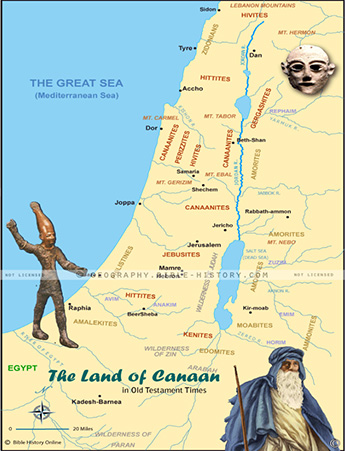
- So Abram departed as YaHaVah had spoken to him, and Lot went with him. And Abram was seventy-five years old when he departed from Haran. Then Abram took Sarai his wife and Lot his brother’s son, and all their possessions that they had gathered, and the people whom they had acquired in Haran, and they departed to go to the land of Canaan. So they came to the land of Canaan. Abram passed through the land to the place of Shechem, as far as the terebinth tree of Moreh. And the Canaanites were then in the land.”
- The question for us is “who were the Canaanites?”
- The Canaanites were ancient people descended from Canaan, the grandson of Noah, who inhabited the land of Canaan, a region significant in biblical narratives.
- The Canaanites are described in the Bible as descendants of Canaan, who was cursed by Noah due to his father’s sin (Genesis 9:20-25). They settled in the land of Canaan, which corresponds to modern-day Israel, Lebanon, and parts of Jordan and Syria. This area is often referred to in the Bible as the Promised Land that God promised to Abraham and his descendants (Genesis 12:6-7).
- It’s fair to say that the peoples of the land of promise worshiped a variety of pagan deities thus polluting Israels land causing it to become ritually unclean. There were giants dwelling within the land of promise although not all Canaanites were giants.
- Abraham erects two more altars to YaHaVah. Ge. 12:8: “And he moved from there to the mountain east of Bethel (house of God), and he pitched his tent with Bethel on the west and Ai on the east; there he built an altar to YaHaVah and called on the name of YaHaVah.” ***Altar number two.
- Ge. 13:18 records the third altar: “So Abram went to live near the great trees of Mamre at Hebron, where he pitched his tents. There he built an altar to YaHaVah.”
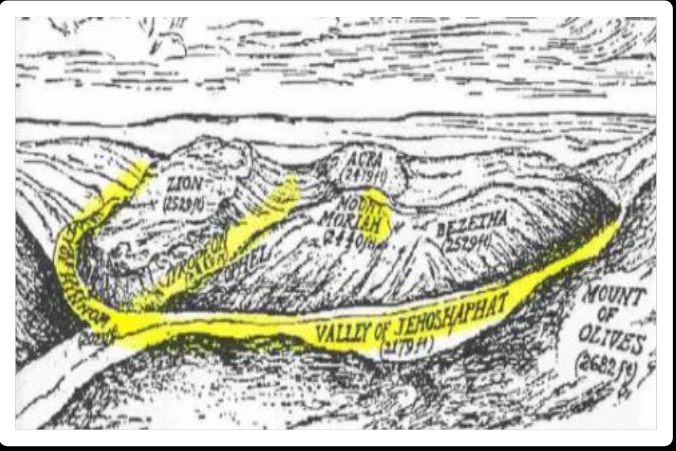
- Bethel and Ai are cities that were positioned on Mt. Moriah. Mt Moriah would become the home of Jerusalem and the temple mount.
- It’s interesting me that there were three altars connecting us to the third letter in the Hebrew Aleph Bet, the Gimel. The Gimel means to lift-up, walk or carry which speaks to our “walk” with The Father through Yeshua.
- A fourth altar was erected to Yah on the Mt. of Olives as recorded in Ge. 22:9: “Then they came to the place of which Yah had told him. And Abraham built an altar there and placed the wood in order; and he bound Isaac his son and laid him on the altar, upon the wood.” This is the altar where Yah instructed Abraham to sacrifice his son Isaac, known as the “binding of Isaac or the Akeidah.” This event was a prophetic picture of the sacrifice of Yahs Son, Yeshua.
- The descendants of Abraham, Isaac and Jacob would also erect altars to YaHaVah. See Ge. 26:25 and Ge. 33:20.
The Mizbeach
- The Hebrew word for “altar” is mizbeach. It is spelled thus; מִזְבֵּחַ . In its ancient form would read: “The mighty have chosen to enter in through the cut covenant which leads to His house by separating ourselves from the world.”
- The numerical value is 57; 5 + 7 = 12. The number twelve speaks to all twelve tribes of Israel.
- It would be during Israels exodus from Egypt that YaHaVah would instruct them to build an altar that could be moved on command in lieu of a stationary altar.
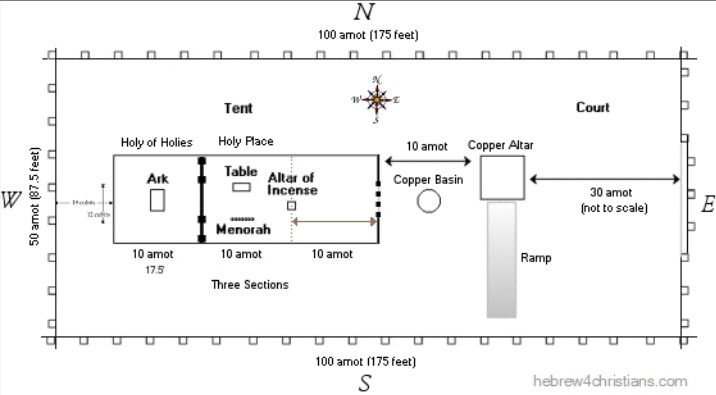
- Ex. 27:1: “You shall make an altar of acacia wood, five cubits long and five cubits wide—the altar shall be square—and its height shall be three cubits. You shall make its horns on its four corners; its horns shall be of one piece with it. And you shall overlay it with bronze. Also you shall make its pans to receive its ashes, and its shovels and its basins and its forks and its firepans; you shall make all its utensils of bronze. You shall make a grate for it, a network of bronze; and on the network you shall make four bronze rings at its four corners.
- You shall put it under the rim of the altar beneath, that the network may be midway up the altar. And you shall make poles for the altar, poles of acacia wood, and overlay them with bronze. The poles shall be put in the rings, and the poles shall be on the two sides of the altar to bear it. You shall make it hollow with boards; as it was shown you on the mountain, so shall they make it.”
- This is the “great altar” that was located in the courtyard of the Mishkan, the Tabernacle in the Wilderness. All of Israels sacrifices to Yah would be spent on this altar. Every time the Mishkan moved so did all the furnishings including the great altar.
- Ex. 40:1 – 10: “Then YaHaVah spoke to Moses, saying: ‘on the first day of the first month you shall set up the tabernacle of the tent of meeting. You shall put in it the ark of the Testimony, and partition off the ark with the veil. You shall bring in the table and arrange the things that are to be set in order on it; and you shall bring in the lampstand and light its lamps. You shall also set the altar of gold for the incense before the ark of the Testimony, and put up the screen for the door of the tabernacle. Then you shall set the altar of the burnt offering before the door of the tabernacle of the tent of meeting. And you shall set the laver between the tabernacle of meeting and the altar, and put water in it. You shall set up the court all around, and hang up the screen at the court gate.
- And you shall take the anointing oil, and anoint the tabernacle and all that is in it; and you shall hallow it and all its utensils, and it shall be holy. You shall anoint the altar of the burnt offering and all its utensils, and consecrate the altar. The altar shall be most holy.”
- This altar is a “set apart” altar in like fashion as the Sabbath day, a “set apart” or holy day. In fact, we can say that this altar is the “altar of the covenant” as it appears thus in the Scripture narrative, אֶת־הַמִּזְבֵּ֔חַ.
- The narrative continues with the sanctification of the Aaronic priesthood.
- The total dedication process lasted for seven days with the eighth day as the beginning of priestly and tabernacle service. Ex. 40:34: “Then the cloud covered the tabernacle of meeting, and the glory of YaHaVah filled the tabernacle.”
- The “glory” covered the Mishkan on the eighth day thereby establishing the significance of the number eight.
- The number eight speaks to sanctification, i.e. separating our self from the world in favor of our service to The Father.
- The Mishkan was still in use during the time of King David. It would be his son Solomon, his successor, that would build a physical temple in Jerusalem. This information is recorded for us in 1st Kings 5:15.
- 1st Chron. 4:1 reads: “Moreover he (King Solomon) made a bronze altar: twenty cubits was its length, twenty cubits its width, and ten cubits its height.”
- This altar is also referred to as the “brazen” altar. This is due to one of the definitions for the word, נְחשֶׁת, which can mean lust or harlotry. In my opinion, lust or harlotry speak to Israel “out of covenant” with their national remedy being the sacrifice of Yom Kippur, the Day of Atonement.
- The protocol having been established for dedicating the tabernacle was used in the dedication of Solomon’s Temple.
- 2nd Ch. 7:8 – 10: “At that time Solomon kept the feast seven days, and all Israel with him, a very great assembly from the entrance of Hamath to the Brook of Egypt. And on the eighth day they held a sacred assembly, for they observed the dedication of the altar seven days, and the feast seven days. On the twenty-third day of the seventh month he sent the people away to their tents, joyful and glad of heart for the good that YaHaVah had done for David, for Solomon, and for His people Israel.”
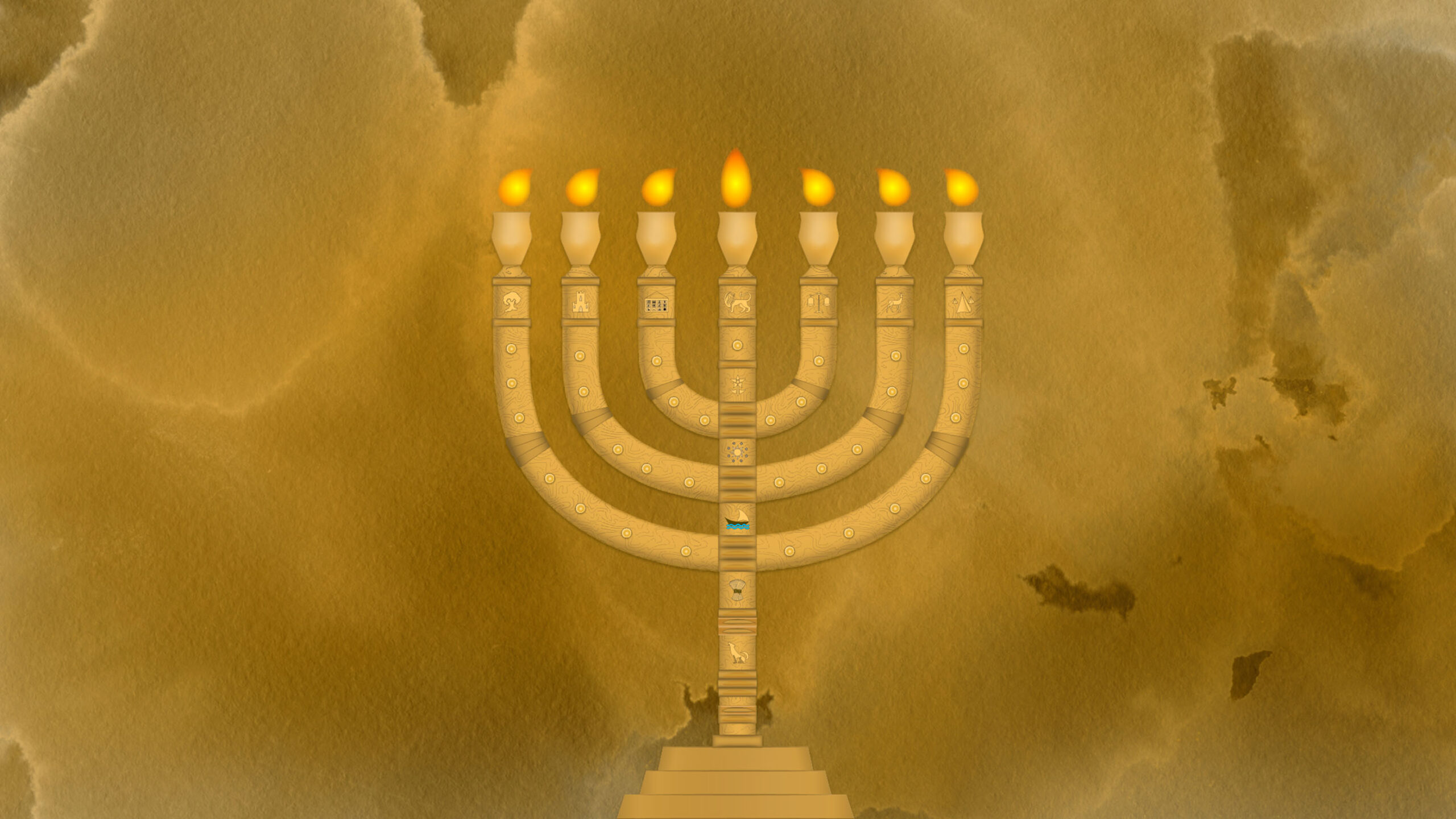
- We just completed the season of Hanukkah wherein the candles burned for eight days.
- A Hellenistic Jewish priest came and sacrificed the pig. Mattathias became so angry that he and his sons killed the priest, and all of the District Inspectors. He shouted for anyone that follows YaHaVah and the Torah to follow him. Many followed him into the desert with their wives and children and lived in caves.
- The priests ( The Maccabean priests) cleansed the Temple and removed the stones from the altar. They built a new altar, Temple Menorah, hung new curtains and rededicated the Temple 3 yrs. to the day, Kislev 25, from the time Antiochus IV defiled it. (The works of Josephus; The Antiquities of the Jews, Book 12/Chapters: 5-8)
- They celebrated the rededication for eight days with rejoicing, in the manner of the feast of booths, remembering how not long before, during the feast of booths, they had been wandering in the mountains and living in caves like wild animals. In order to understand why the observance of Hanukkah is so important, the Rabbis recount the story of the miraculous jar of oil that burned for eight days. Since eight is the number of new beginnings, separation, covenant, and dedication is it not entirely possible that this particular jar of oil lasted for eight days. ( The Light of Torah, Terry Reid, Hanukkah 2025)
- The story of the rededication presents, to me at least, a prophetic picture of the coming Messiah Yeshua, the “light of the world.”
- To date, there is yet one more temple to be built. This is recorded for us in Ezekiel 43:18 – 20: “And He (Yeshua) said to me, ‘son of man, thus says YaHaVah Elohay: these are the ordinances for the altar on the day when it is made, for sacrificing burnt offerings on it, and for sprinkling blood on it. You shall give a young bull for a sin offering to the priests, the Levites, who are of the seed of Zadok, who approach Me to minister to Me,’ says YaHaVah Elohay. You shall take some of its blood and put it on the four horns of the altar, on the four corners of the ledge, and on the rim around it; thus you shall cleanse it and make atonement for it.’”
- Solomon’s Temple was restored by Ezra upon his return from the Babylonian captivity. This is the Temple that was in operation during Messiah Yeshuas’ first advent.
- This Temple was destroyed by Rome in 70 A.D. leaving Israel with no means or ability to worship Our Father according to His ancient protocols.
- Fortunately, the prophet Ezekiel promises another Temple. A Temple that was initiated by Yeshua himself in Ez. 40:1 – 4.
- Which reads: “In the twenty-fifth year of our captivity, at the beginning of the year, on the tenth day of the month, in the fourteenth year after the city was captured, on the very same day the hand of YaHaVah was upon me; and He took me there. In the visions of Yah He took me into the land of Israel and set me on a very high mountain; on it toward the south was something like the structure of a city. He took me there, and behold, there was a man whose appearance was like the appearance of bronze. He had a line of flax and a measuring rod in his hand, and he stood in the gateway. And the man said to me, ‘son of man, look with your eyes and hear with your ears, and fix your mind on everything I show you; for you were brought here so that I might show them to you. Declare to the house of Israel everything you see.’”
- Ez. 43:7 tells us who the man is: “And He said to me, ‘son of man, this is the place of My throne and the place of the soles of My feet, where I will dwell in the midst of the children of Israel forever. No more shall the house of Israel defile My holy name, they nor their kings, by their harlotry or with the carcasses of their kings on their high places.’”
- There is only one man who will sit on this throne, that is Yeshua HaMashiach. He will sit on this throne during His 1000 millennial reign.
- This Temple will be inaugurated as per the Torah protocol.
- Ez. 43:25 – 27: “Every day for seven days you shall prepare a goat for a sin offering; they shall also prepare a young bull and a ram from the flock, both without blemish. Seven days they shall make atonement for the altar and purify it, and so consecrate it. When these days are over it shall be, on the eighth day and thereafter, that the priests shall offer your burnt offerings and your peace offerings on the altar; and I will accept you,’ says YaHaVah Elohay.”
- The very same protocol that was established in Torah with the inauguration of the Mishkan, the Tabernacle in the Wilderness, will be used to inaugurate Ezekiel’s Temple as well. This inauguration will establish Yeshuas preeminence on earth as He will reign for 1000 years.
- In conclusion, altars that were erected to YaHaVah established His preeminence on earth.
- Altars could be stationary as compared to the “great altar” of the Mishkan which was relocated each time the Mishkan was moved.
- The protocol for inaugurating the altar was established in Torah so it was expected that the Maccabees, when dedicating the restored temple and furnishings, would follow Torah exactly. Ezekiel’s Temple will dedicate that future temple exactly as prescribed.
- One final thought, what a joyful experience to be a part of, for those of us who desire to serve King Messiah during His reign. When this Temple is inaugurated His appearing for the second time, is immanent.
- Glory to Yah in the heavens!