Sh’mot (Exodus) 30:11 – 34:35
Haftarah: M’lakhim Aleph (1st Kings) 18:20 – 39 and Num. 19:1 – 22
Brit Chadasha: Lk. 11:14 – 20; Acts 7:35 – 8:1; 1st Corin. 10:1 – 13 and 2nd Corin. 3:1 – 18
כִּ֣י תִשָּׂ֞א – meaning “when to lift, bear up, carry or take”
- Parasha Highlights:
- Moshe is directed by YaHaVah to “count the head” of the children of Israel.
- The “temple” tax is initiated for the work of the Tent of Meeting.
- The first and second sets of the “Luchot Ha Brit” are given (tablets of the testimony).
- The golden calf is fashioned thus breaking Israels part of the betrothal agreement.
- The Levites redeem themselves from the incident at Shechem and dedicate themselves to YaHaVah.
- This parasha is filled to overflowing with Scriptural nuggets. Our sidra begins with a census commanded by YaHaVah.
- Next is the “water laver” used for the priestly washing thus connecting us to the second day of creation.
- Then comes the instruction for the “oil of sacred anointment,” a link to the Mashiach.
- The “oil of sacred anointment” is followed by the “holy incense.”
The Census
- Ex. 30:11: “Then YaHaVah spoke to Moses, saying: ‘when you take the census (אֶת־רֹ֥אשׁ 1) of the children of Israel for their number, then every man shall give a ransom (כֹּפֶר 2 ) for himself to YaHaVah, when you number them, that there may be no plague among them when you number them.
- 1. Notice the Aleph Tav; those that are being numbered are covenant believers. By the count, we now know that the “whole house of Israel,” i.e. the covenant believers are present and accounted for.
- The “head-rosh” of the covenant believer is Yeshua. The first letter of Scripture, the oversized Bet, tells us Yeshua is the “rosh” of His family, the qahal.
- Col. 1:18: “And he (Yeshua) is the head of the body, the qahal; he is the beginning and the firstborn from among the dead, so that in everything he might have the supremacy.”
- 1st Cor. 12:17: “Now you are the body of Messiah, and each one of you is a part of it.”
- Eph. 1:22-23: “And Yah put everything under His feet and made Him head over everything for the qahal, which is His body, the fullness of Him who fills all in all.”
- 2. The Hebrew word for ransom or atonement is “koper,” כֹּפֶר. Koper can mean price of a life, ransom, bribe or covering. In its ancient form this word would read: “Cover or open your mouth and speak of Him who was from the beginning.”
- In their day and hour, the ransom was paid by the half shekel. It was given to YaHaVah to atone for their soul. In our day and hour, Yeshua, having given Himself to The Father, is our atoning ransom. Yeshua is our covering, our “koper.”
- 1st Jn. 2:2: “He Himself is the atoning sacrifice for our sins, and not only for ours but also for the sins of the whole world.
- What we speak is our witness to the glory of Yah. Rom. 10:8 – 10: “But what does it say? ‘The word is near you, in your mouth and in your heart” (that is, the word of faith which we preach): that if you confess with your mouth the Lord Yeshua and believe in your heart that Yah has raised Him from the dead, you will be saved. For with the heart one believes unto righteousness, and with the mouth confession is made unto salvation.”
- The numerical value of koper is 300. The atonement or ransom will have something to do with the resurrection of Yeshua on day three.
The Laver
- The resurrection of Yeshua speaks to day two of creation, the separating of the waters. Ex. 30:17 – 21: “Then YaHaVah spoke to Moses, saying: ‘you shall also make a laver of bronze, with its base also of bronze, for washing. You shall put it between the tabernacle of meeting and the altar. And you shall put water in it, for Aaron and his sons shall wash their hands and their feet in water from it. When they go into the tabernacle of meeting, or when they come near the altar to minister, to burn an offering made by fire to YaHaVah, they shall wash with water, lest they die.
- So they shall wash their hands and their feet, lest they die. And it shall be a statute forever to them—to him and his descendants throughout their generations.”
- This is a curious instruction. Why must the priesthood go back and forth to wash? Perhaps the answer is found in Ge. 1:6: “Then Yah said, ‘let there be a firmament in the midst of the waters, and let it divide the waters from the waters. Thus Yah made the firmament, (אֶת־הָרָקִיעַ֒ ) and divided the waters which were under the firmament from the waters which were above the firmament; and it was so. And Yah called the firmament Heaven. So the evening and the morning were the second day.”
- The firmament, the Aleph Tav Raquia, separates earth and heaven. Yeshua is the Aleph Tav who separates, acting as a mediator, heaven and earth.
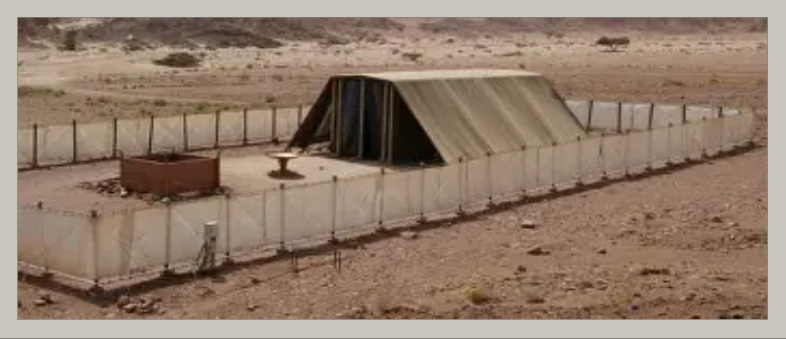
- There is an imaginary line between the great altar and the water laver which is the firmament, the Aleph Tav Raquia. The great altar represents earth and the water laver represents heaven with Yeshua the mediator in between. Essentially, Yeshua is presenting the sacrifice to YaHaVah.
- The priesthoods going back and forth from the great altar to the water laver is a picture of our spiritual sacrifices being presented to The Father by Yeshua. This would be the same pattern Yeshua would use in presenting Himself to The Father.
The Oil of Anointment
- Ex. 30:22 – 33: “Moreover YaHaVah spoke to Moses, saying: ‘also take for yourself quality spices—five hundred shekels of liquid myrrh, half as much sweet-smelling cinnamon (two hundred and fifty shekels), two hundred and fifty shekels of sweet-smelling cane, five hundred shekels of cassia, according to the shekel of the sanctuary, and a hin of olive oil. And you shall make from these a holy anointing oil, an ointment compounded according to the art of the perfumer. It shall be a holy anointing oil. With it you shall anoint the tabernacle of meeting and the ark of the Testimony;
- the table and all its utensils, the lampstand and its utensils, and the altar of incense; the altar of burnt offering with all its utensils, and the laver and its base. You shall consecrate them, that they may be most holy; whatever touches them must be holy. And you shall anoint Aaron and his sons, and consecrate them, that they may minister to Me as priests.’ And you shall speak to the children of Israel, saying: ‘this shall be a holy anointing oil to Me throughout your generations. It shall not be poured on man’s flesh; nor shall you make any other like it, according to its composition. It is holy, and it shall be holy to you. Whoever compounds any like it, or whoever puts any of it on an outsider, shall be cut off from his people.’”
- The Hebrew word for “anoint” is מָשַׁח, the root word for Mashiach. To be an anointed one is to be set apart or consecrated for service to YaHaVah. In past years we have discussed the oil itself. This year I would like to discuss the articles of furniture which are to be anointed and set apart.
- The Mishkan itself is first, the tents outer covering for the furniture. See Ex. 26:1 – 35, Parasha Terumah. This subject requires a separate teaching. Suffice to say, the Mishkan will act as a physical mediator of sorts. Israel can only approach YaHaVah through the prescribed pattern with atonement or covering, occurring one day a year on Yom Kippurim.
- The Ark of the Testimony holds the two witnesses to the covenant made between The Father and Abraham, i.e. the two stone tablets carved with the Ten Words. All believers will be judged by Yeshua based on the two witnesses.
- This brings to mind the “two witnesses” of Revelation 11. What do you think they will be preaching to Israel? Todays Israel remains out of covenant in at least two ways; they worship Rabbinic Judaism or they are secular. In my opinion, the “two witnesses” will speak to the nation of their return to the “Luchot HaBrit,” the original “two witnesses.”
- Jn. 1:1 and Jn. 1:14 Scripture speaks to the Word becoming flesh. Yeshua is the Word made flesh and dwelt among us. I must tell you that the phrase “God was the word” is in brackets in the Polyglot Septuagint. This suggests a scribal entry only. Yeshua is the living word by which we will all be judged.
- The prophet Zechariah also speaks of “two witnesses,” the two olive trees. Zechariah 4:1 – 3: “Now the angel who talked with me came back and wakened me, as a man who is wakened out of his sleep. And he said to me, ‘what do you see?’ So I said, ‘I am looking, and there is a lampstand of solid gold with a bowl on top of it, and on the stand seven lamps with seven pipes to the seven lamps. Two olive trees are by it, one at the right of the bowl and the other at its left.’”
- Since Israel is referred to as the “green olive tree” in Jer. 11:16: “YaHaVah called your name (Israel), Green Olive Tree, Lovely and of Good Fruit. With the noise of a great tumult He has kindled fire on it, and its branches are broken.” See also Rom 11.
- It’s not a stretch to see that the two olive trees of Zechariah are the Northern and Southern kingdoms of Israel. Also “two witnesses.”
- The third article of furniture is the Table of Shewbread. This item represents the complete provision of Yah.
- The Table of Shewbread would hold yet another witness. Twelve loaves of bread representing the twelve tribes of Israel, i.e. the Whole House of Israel, those who were counted in the census.
- The Table of Shewbread lives on the north side of the holy place. Ex 25:22 – 23 commentary.
- Jer. 6:22 and 50:41 speak to a great army coming against Israel from the north. The Table of Shewbread speaks not only to The Fathers faithful provision to Israel but her judgment when she is disobedient.
- Jn. 6:35: “And Yeshua said to them, ‘I am the bread of life. He who comes to Me shall never hunger, and he who believes in Me shall never thirst.” **The Table of Shewbread then, speaks to the unity of Yeshua and the Whole House of Israel.
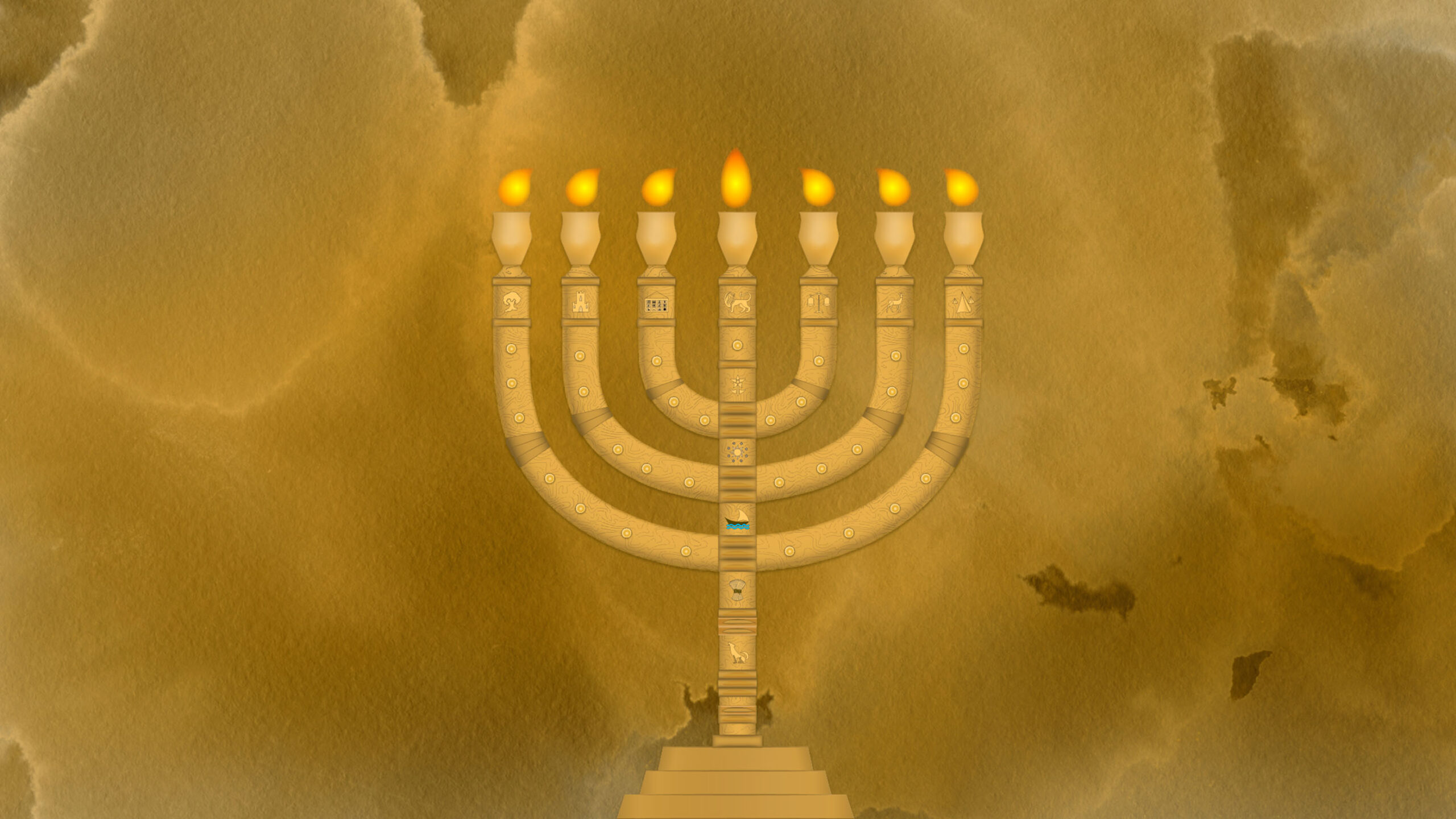
- Opposite the Table of Shewbread is the golden Menorah, the only light in an otherwise completely dark space. Recall day one of creation when the earth was dark. Yah spoke His light into the world in the form of the Aleph Tav Yeshua; another dark space with only The Fathers light in it. The seven branch Menorah is a representation of the week of creation, Yahs festival cycle and mans time on earth. The week of creation being a table of contents for all physical time.
- We will finish part one of Ki Tisa with the Altar of Incense. The Altar of Incense will reside in the Holy Place opposite the Ark of the Testimony. The “holy incense” contains the following ingredients:
- Stacte 70 Maneh
- Onycha “
- Galbanum “
- Pure Frankincense “
- Balsam Oil 16 Maneh
- Musk “
- Cassia “
- Spikenard “
- Costus 12 Maneh
- Aromatic Bark 3 Maneh
- Cinnamon 9 Maneh
- Total Compound 368 = 17
- The holy incense is a representation of Yeshua whose resurrection occurred on the 17th day of the first month.
- The Hebrew word for incense is קְטֹרֶת. What a truly great word. The first letter, the Quph, is a picture of the back of the head. This word tells us that this person is facing the Ark of Testimony with the back of his head against the world system, Yeshua! The second letter, the Tet, means to surround or contain. This is a person who is completely enveloped in the container, Yeshua! The third letter, the Resh, which means first beginning or head tells us this person was from the beginning, Yeshua! The fourth letter, the Tav, tells us He is a covenant man, Yeshua!
- Incense is also an offering. Rev. 8:3 – 4: “Then another angel, who had a golden censer, came and stood at the altar. He was given much incense to offer, along with the prayers of all the saints, on the golden altar before the throne. And the smoke of the incense, together with the prayers of the saints, rose up before Yah from the hand of the angel.”
- There is an interesting twist to this years parasha reading of Ki Tisa. One of the suggested connections comes to us from Parasha Chukat, the Red Heifer sacrifice. This is a new development so I really had to investigate. What does the Red Heifer sacrifice have to do with what we have read and studied so far?
Haftarah
- Num. 19:1 – 10: “Now YaHaVah spoke to Moses and Aaron, saying, ‘this is the ordinance of the law which YaHaVah has commanded, saying: speak to the children of Israel, that they bring you a red heifer without blemish, in which there is no defect and on which a yoke has never come. You shall give it to Eleazar the priest, that he may take it outside the camp, and it shall be slaughtered before him; ‘and Eleazar the priest shall take some of its blood with his finger, and sprinkle some of its blood seven times directly in front of the tabernacle of meeting. Then the heifer shall be burned in his sight: its hide, its flesh, its blood, and its offal shall be burned.
- And the priest shall take cedar wood and hyssop and scarlet, and cast them into the midst of the fire burning the heifer. Then the priest shall wash his clothes, he shall bathe in water, and afterward he shall come into the camp; the priest shall be unclean until evening. And the one who burns it shall wash his clothes in water, bathe in water, and shall be unclean until evening. Then a man who is clean shall gather up the ashes of the heifer, and store them outside the camp in a clean place; and they shall be kept for the congregation of the children of Israel for the water of purification; it is for purifying from sin. And the one who gathers the ashes of the heifer shall wash his clothes, and be unclean until evening. It shall be a statute forever to the children of Israel and to the stranger who dwells among them.
- The cedar wood, hyssop and scarlet all speak to the death of Yeshua. He took the sins of the world on His shoulders causing Him to be unclean. He surrendered His life “outside the camp.” He is the living water, the water of purification. His sacrifice was given for the “Whole House of Israel.”
- Yeshua became unclean then He became clean!
- The connection to our sidra and the Red Heifer sacrifice are twofold. The concept of the Mishkan and the Red Heifer sacrifice relate to ritual purification. There are also seven steps to mans redemption.
- Man brings his sacrifice to the priest
- The priest prepares and makes the offering on the great altar
- The priest walks back and forth to the water laver for ritual washing
- The Menorah provides light
- The Table of Shewbread provides provision
- The altar of incense the ritual smoke before the Ark of the Testimony
- The Ark of the Testimony is the place where atonement is achieved
Brit Chadasha
- Lk. 11:14-20: “But if I drive out demons by the finger of Elohim, then the Kingdom of Elohim has come upon you.” **Referring to the “Word” of YaHaVah.
- Acts 7:35-8:1 and 1st Corin. 10:1 – 13: Making the golden calf.
- 2nd Corin. 3:1 – 18: “The veil Moshe wore after having been in the presence of YaHaVah.”
- In conclusion of part one: The message was given to the Whole House of Israel, for their benefit.
- The head of the qahal is Yeshua, our covering. Yeshua is the living water, that fills the water laver. He is our mediator, the firmament between heaven and earth. Many of the spices, if not all, used in the oil of anointment were also used as His burial spices, Jn 19:39-40.
- The Mishkan and the Red Heifer sacrifice speak to the work of Yeshua for His remnant bride.