Sh’mot (Exodus) 13:17 – 17:15
Haftarah: Shof’tim (Judges) 5:1 – 31
Brit Chadasha: Lk. 2:22 – 24; Jn. 6:25 – 35, 19:31:37
1 Corin. 10:1 – 13; 2 Corin. 8:1 – 5 and Rev. 15:1 – 4
Parasha Bo Recap
- There are two points I would like to discuss before we begin this weeks Parasha.
- The first point is the tenth plague, the death of the firstborn. Ex. 12:29: “And it came to pass at midnight that YaHaVah struck all the firstborn in the land of Egypt, from the firstborn of Pharaoh who sat on his throne to the firstborn of the captive who was in the dungeon, and all the firstborn of livestock.”
- The death of the firstborn is a prophetic picture of the first advent of the Mashiach. He too is a firstborn, the firstborn of YaHaVah. Col. 1:13 – 15: “He has delivered us from the power of darkness and conveyed us into the kingdom of the Son of His love, in whom we have redemption through His blood, the forgiveness of sins. He is the image of the invisible Yah, the firstborn over all creation.”
- In Parasha V’eria (Ex. 6:2 – 9:35) we discussed the first plague of water and blood. Now the tenth plague of the death of the firstborn. Both are prophetic pictures of the work of Messiah Yeshua at His first advent. 1 + 10 = 11! The numerical value of Y’sha.
- The second point is the instruction regarding the first Pesach.
- Ex. 12:1 – 7: “Now YaHaVah spoke to Moses and Aaron in the land of Egypt, saying, ‘this month shall be your beginning of months; it shall be the first month of the year to you. Speak to all the congregation of Israel, saying: on the tenth of this month every man shall take for himself a lamb, according to the house of his father, a lamb for a household. Your lamb shall be without blemish, a male of the first year. You may take it from the sheep or from the goats. Now you shall keep it until the fourteenth day of the same month. Then the whole assembly of the congregation of Israel shall kill it at twilight.
- And they shall take some of the blood and put it on the two doorposts and on the lintel of the houses where they eat it.’”
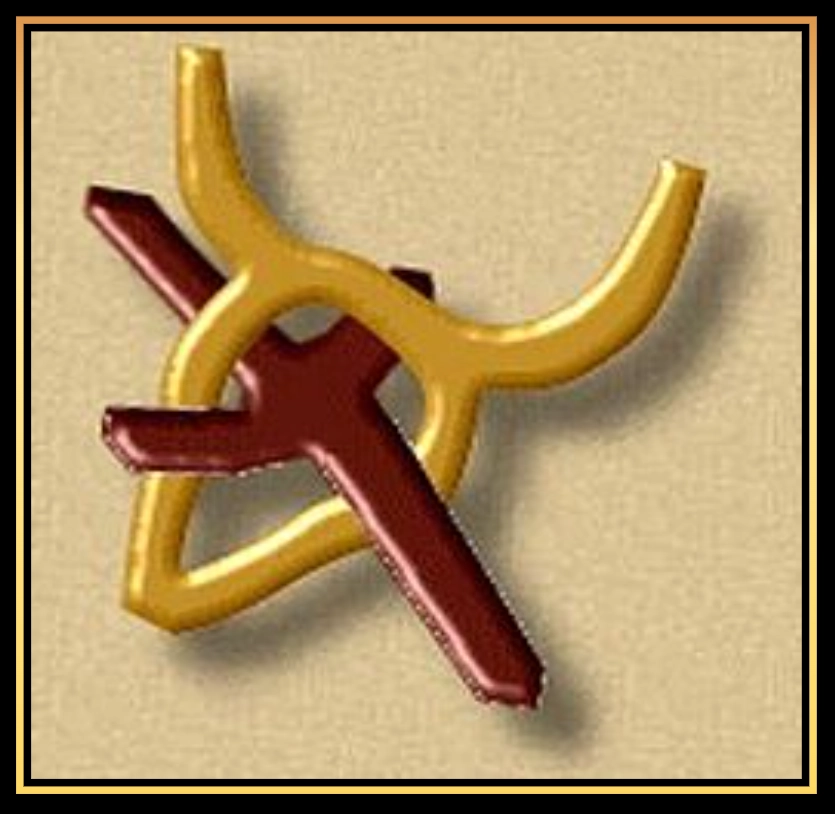
- The blood on the doorposts and lintels relates to the twenty second letter of the Hebrew Aleph Bet, the Tav. The Tav is a picture of crossed sticks, two sticks, and means mark, seal or covenant. The point is the lambs blood while staying inside the dwelling meant that family chose to enter into a covenant relationship with Yah.
- Keep this in mind as we discuss Parasha B’Shalach.
Parasha B’Shalach
בְּשַׁלַּ֣ח meaning “to send, send away, let go or stretch out”
- Parasha Highlights:
- Salvation for the mixed multitude as the first redemption begins
- Three issues with water
- Israel, the seed, is fed manna, the bread from heaven
- Israel has no water, the grumbling begins
- Israel has been in physical and spiritual bondage for centuries. Now that they’ve been delivered by The Father, what is their level of faith, emunah?
- My understanding is that during their captivity, they didn’t circumcise their male children. This tells us that they didn’t think of themselves as covenant people. They really had no way to worship YaHaVah during this period of their history.
- Israels’ wilderness journey had many facets. Building their faith would be foremost. Keep in mind they had just witnessed the power of El Shaddais’ ten plagues.
- Ex. 14:1 – 4: “Now YaHaVah spoke to Moshe, saying: ‘speak to the children of Israel, that they turn and camp before Pi Hahiroth, between Migdol and the sea, opposite Baal Zephon; you shall camp before it by the sea.’ For Pharaoh will say of the children of Israel, ‘they are bewildered by the land; the wilderness has closed them in.’ Then I will harden Pharaoh’s heart, so that he will pursue them; and I will gain honor (I will be glorified) over Pharaoh and over all his army, that the Egyptians may know that I am YaHaVah. And they did so.”
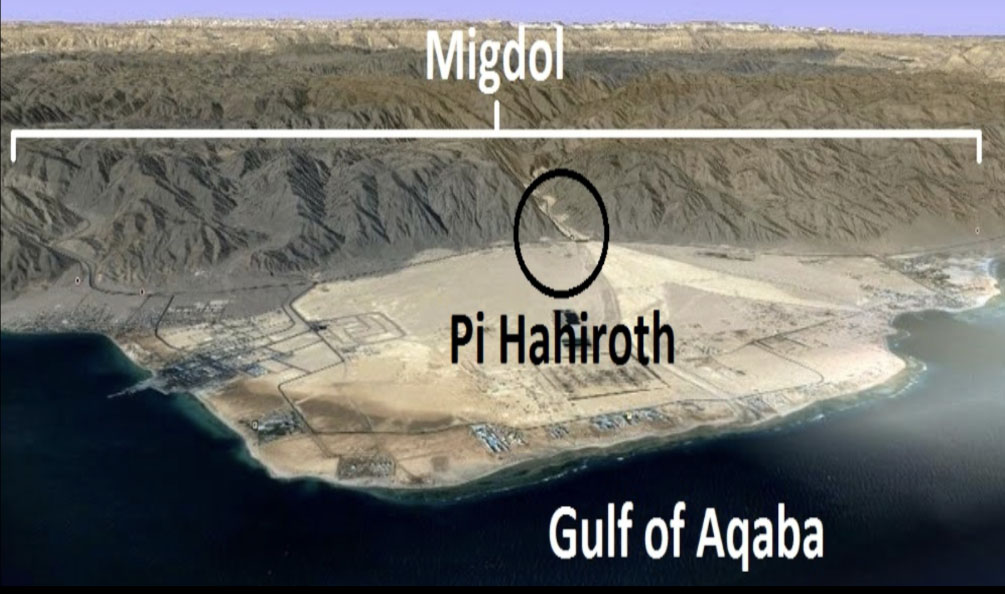
- This location is a gorge, like a birth canal. The mixed multitude must be “birthed” like the infant nation they are. The Sea of Reeds lies in front of them with Pharaoh and his army behind them. They have no choice but to go forward through the “waters of salvation.” It will be the Aleph Tav Yeshua that will cause to birth the House of Israel.
- Ex. 14:13-18: “And Moshe said to the people, ‘do not be afraid. Stand still, and see the salvation (אֶת־יְשׁוּעַת ) of YaHaVah, which He will accomplish for you today. For the Egyptians whom you see today, you shall see again no more forever. YaHaVah will fight for you, and you shall hold your peace. And YaHaVah said to Moshe, ‘why do you cry to Me? Tell the children of Israel to go forward. But lift up your rod (אֶֽת־מַטְּךָ ) and stretch out your hand (אֶת־יָדְךָ ) over the sea and divide it.
- And the children of Israel shall go on dry ground through the midst of the sea. And I indeed will harden the hearts of the Egyptians, and they shall follow them. So I will gain honor over Pharaoh and over all his army, his chariots, and his horsemen. Then the Egyptians shall know that I am YaHaVah, when I have gained honor (glory) for Myself over Pharaoh, his chariots, and his horsemen.’”
- The salvation of the mixed multitude occurred first. They had to exercise their faith, their emunah, by walking through the water. The sages say that it was Nachshon, son of Aminadav, leader of the tribe of Judah, walked into the water chest deep as an act of faith. (Encyclopedia of Biblical Personalities, pages 416 and 417)
- Following the lead of Nachshon, the mixed multitude marched through the water. They were on their way to becoming the seed, i.e. the spiritual seed of Abraham.

Yeshua
- This is how the word “salvation” appears in the Scripture narrative, אֶת־יְשׁוּעַת . This is a feminine noun which speaks to covenant Israel as the bride of Yeshua, who is the bridegroom.
- The numerical value of Yeshuat is 786; 7 + 8 + 6 = 21, reducing to a single digit 2 + 1 = 3. In its ancient form would read: “The maker and divine power will add those who are watchful of His covenant.” Salvation is associated with water and seed.
- Ex. 15:22 – 26: “So Moshe brought Israel (אֶת־יִשְׂרָאֵל ) from the Red Sea; then they went out into the Wilderness of Shur. And they went three days in the wilderness and found no water. Now when they came to Marah, they could not drink the waters of Marah, for they were bitter. Therefore the name of it was called Marah. And the people complained against Moshe, saying, ‘what shall we drink?’ So he cried out to YaHaVah, and YaHaVah showed him a tree. When he cast it into the waters, the waters were made sweet. There He made a statute and an ordinance for them, and there He tested them and said, ‘if you diligently heed the voice of YaHaVah your Elohay and do what is right in His sight, give ear to His commandments and keep all His statutes, I will put none of the diseases on you which I have brought on the Egyptians. For I am YaHaVah who heals you.’”
- Israels’ bitterness = a spirit of unbelief or rebellion. Heb. 3:7 – 11: “So, as the Holy Spirit says: ‘today, if you hear his voice, do not harden your hearts as you did in the rebellion, during the time of testing in the wilderness, where your ancestors tested and tried me, though for forty years they saw what I did. That is why I was angry with that generation; I said, their hearts are always going astray, and they have not known my ways.’ So I declared on oath in my anger, they shall never enter my rest.”
- Heb. 12:15: “Looking carefully lest anyone fall short of the grace of Yah; lest any root of bitterness springing up cause trouble, and by this many become defiled.”
- This early unbelief brought about spiritual adultery, thus began Israels cycle of rebellion, judgment, repentance followed by restoration.
- Israels cyclical rebellion equals spiritual adultery. In fact, there is a test given for suspected adultery recorded in Num. 5:11 -22: “And YaHaVah spoke to Moses, saying, ‘speak to the children of Israel, and say to them: if any man’s wife goes astray and behaves unfaithfully toward him, and a man lies with her carnally, and it is hidden from the eyes of her husband, and it is concealed that she has defiled herself, and there was no witness against her, nor was she caught—if the spirit of jealousy comes upon him and he becomes jealous of his wife, who has defiled herself; or if the spirit of jealousy comes upon him and he becomes jealous of his wife, although she has not defiled herself—
- then the man shall bring his wife to the priest. He shall bring the offering required for her, one-tenth of an ephah of barley meal; he shall pour no oil on it and put no frankincense on it, because it is a grain offering of jealousy, an offering for remembering, for bringing iniquity to remembrance. And the priest shall bring her near, and set her before YaHaVah. The priest shall take holy water in an earthen vessel, and take some of the dust that is on the floor of the tabernacle and put it into the water. Then the priest shall stand the woman before YaHaVah, uncover the woman’s head, and put the offering for remembering in her hands, which is the grain offering of jealousy. And the priest shall have in his hand the bitter water that brings a curse.
- And the priest shall put her under oath, and say to the woman, if no man has lain with you, and if you have not gone astray to uncleanness while under your husband’s authority, be free from this bitter water that brings a curse. But if you have gone astray while under your husband’s authority, and if you have defiled yourself and some man other than your husband has lain with you—then the priest shall put the woman under the oath of the curse, and he shall say to the woman—YaHaVah make you a curse and an oath among your people, when YaHaVah makes your thigh rot and your belly swell and may this water that causes the curse go into your stomach, and make your belly swell and your thigh rot. Then the woman shall say, amen, so be it.’”
- This test was used in diverse cultures for centuries to determine the faithfulness of the wife, whether true or false. It is also a metaphor used to describe the behavior of Israel throughout the centuries.
- In my opinion, there is one betrothed bride, one wife for the Mashiach and that is Israel alone. Every Scripture that makes a reference to the unfaithfulness of a woman toward her husband is speaking of Israel and Yeshua.
- Another example is the two prostitutes with regard to King Solomon.
- 1st Kings 3:16 – 28: “Now two women who were harlots came to the king, and stood before him. And one woman said, ‘O my lord, this woman and I dwell in the same house; and I gave birth while she was in the house. Then it happened, the third day after I had given birth, that this woman also gave birth. And we were together; no one was with us in the house, except the two of us in the house. And this woman’s son died in the night, because she lay on him. So she arose in the middle of the night and took my son from my side, while your maidservant slept, and laid him in her bosom, and laid her dead child in my bosom. And when I rose in the morning to nurse my son, there he was, dead. But when I had examined him in the morning, indeed, he was not my son whom I had borne. Then the other woman said,
- ‘No! But the living one is my son and the dead one is your son.’ And the first woman said, ‘no! but the dead one is your son, and the living one is my son.’ Thus they spoke before the king. And the king said, ‘the one says, this is my son, who lives, and your son is the dead one’; and the other says, ‘no! but your son is the dead one, and my son is the living one.’ Then the king said, ‘bring me a sword.’ So they brought a sword before the king. And the king said, ‘divide the living child in two, and give half to one, and half to the other.’ Then the woman whose son was living spoke to the king, for she yearned with compassion for her son; and she said, ‘O my lord, give her the living child, and by no means kill him!’ But the other said, ‘let him be neither mine nor yours, but divide him.’
- So the king answered and said, ‘give the first woman the living child, and by no means kill him; she is his mother.’ And all Israel heard of the judgment which the king had rendered; and they feared the king, for they saw that the wisdom of Yah was in him to administer justice.”
- The two women represent the divided kingdom of Israel; Judah, the Southern Kingdom and Israel, the Northern Kingdom. Both are “out of covenant” because they are both referred to as harlots.
- The same house is, of course, the Whole House of Israel.
- The infant son is the Mashiach.
Haftarah
- Shof’tim (Judges) 5:1 – 31
- The connection to the Torah portion is as follows:
- The Torah portion gives us the “song of the sea.” Ex. 15:1 – 19 The Haftarah gives us the Judge Deborah’s “song.” Deborah was the 4th judge of Israel, yet another messianic connection.
Brit Chadasha
- Lk. 2:30-32: “For my eyes have seen Your salvation which You have prepared before the face of all peoples, a light to bring revelation to the Gentiles, and the glory of Your people Israel.”
- Jn. 6:25-35: v 31 “Our fathers ate the manna in the desert; as it is written, He gave them bread from heaven to eat. Then Yeshua said to them, ‘most assuredly, I say to you, Moshe did not give you the bread from heaven, but My Father gives you the true bread from heaven.’”
- Jn. 19:37: “They will look at him whom they have pierced.” (To see the connection we must also examine Zech. 10:6 – 12. These passages refer to the 2nd Exodus since the 1st Exodus was long ago. A gathering of the people etc.)
- 1st Corin. 10:1 – 4: “Moreover, brethren, I do not want you to be unaware that all our fathers were under the cloud, all passed through the sea, all were baptized into Moshe in the cloud and in the sea all ate the same spiritual food, (Manna) and all drank the same spiritual drink. For they drank of that spiritual Rock that followed them, and that Rock was Messiah.”
- 2nd Corin. 8:15: “As it is written, He that had gathered much had nothing left over; and he that had gathered little had no lack.” Speaking of the daily bread, the omer (Ex. 16:18)
- In conclusion, recall a “tree” was placed in the bitter waters of Marah. The tree speaks to the death of the Mashiach.
- Gal. 3:13: “Messiah has redeemed (saved) us from the curse of the law, being made a curse for us: for it is written, cursed is every one that is hanged on a tree.”
- The lower waters and all seed bearing vegetation, namely trees, were a creation from day three. The third letter of the Aleph Bet is the Gimel which speaks to lifting up, our walk, i.e. after the footsteps of Messiah Yeshua, and carrying.
- Yeshua was lifted up for all mankind. Our covenant walk is to follow Him as he carries our burdens on His shoulders for our sake.
- Yeshuas death on a tree is the remedy for all bitter rebellion. His death and resurrection invites all men to repent and be restored to the Household of faith, the covenant family of Israel.
- One more thing to consider is that once we make the choice to walk with Him, He agrees to keep His part of the covenant. That means we can trust Him completely, like Abraham did, never doubting that He will keep His word. We don’t want to walk in bitter rebellion of unbelief.